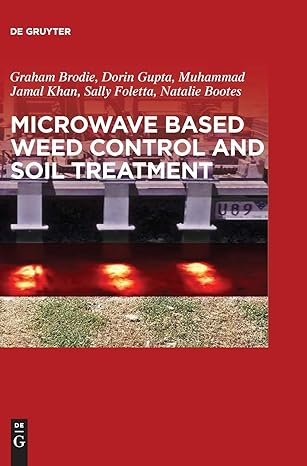
Microwave Based Weed Control and Soil Treatment
by: Graham Brodie (Author)
Publisher: De Gruyter Open Poland
Publication Date: 2018/12/17
Language: English
Print Length: 185 pages
ISBN-10: 3110605198
ISBN-13: 9783110605198
Book Description
Herbicide resistance has become an important constraint on mode agricultural practices. An alarming increase in weed biotypes that are resistant to herbicides has also been reported. Opportunity exists for a novel weed management technology, which is also compatible with no-till agricultural practices. Microwave heating can kill both emerged weed plants and weed seeds in the soil. When the intensity of the microwave fields is moderate, plants, which have already emerged, are susceptible to microwave treatment. If the microwave field is intense enough, very rapid volumetric heating and some thermal runaway in the plant structures cause micro-steam explosions in the plant cells, which rupture the plant structures, leading to death. Soil treatment requires significantly more energy; however, there are secondary benefits for crops growing in microwave treated soil. These include: significant reduction of the dormant weed seed bank; significant reduction of nematode populations; significant reduction of fungal populations; better availability of indigenous nitrogen for the plants; more rapid humification; and significant increases in crop growth and yield. Microwave weed management and soil treatment is not restricted by weather conditions; therefore, the technology may offer some timeliness and environmental benefits, which are yet to be quantified in a cropping system.
About the Author
Herbicide resistance has become an important constraint on mode agricultural practices. An alarming increase in weed biotypes that are resistant to herbicides has also been reported. Opportunity exists for a novel weed management technology, which is also compatible with no-till agricultural practices. Microwave heating can kill both emerged weed plants and weed seeds in the soil. When the intensity of the microwave fields is moderate, plants, which have already emerged, are susceptible to microwave treatment. If the microwave field is intense enough, very rapid volumetric heating and some thermal runaway in the plant structures cause micro-steam explosions in the plant cells, which rupture the plant structures, leading to death. Soil treatment requires significantly more energy; however, there are secondary benefits for crops growing in microwave treated soil. These include: significant reduction of the dormant weed seed bank; significant reduction of nematode populations; significant reduction of fungal populations; better availability of indigenous nitrogen for the plants; more rapid humification; and significant increases in crop growth and yield. Microwave weed management and soil treatment is not restricted by weather conditions; therefore, the technology may offer some timeliness and environmental benefits, which are yet to be quantified in a cropping system.