 Wow! eBook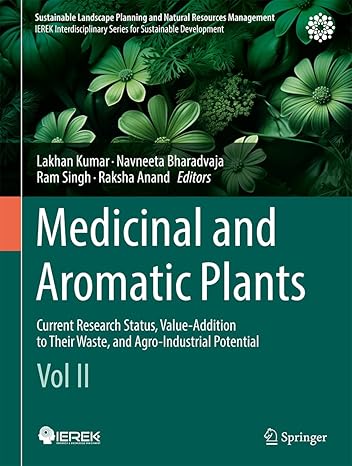
Medicinal and Aromatic Plants: Current Research Status, Value-Addition to Their Waste, and Agro-Industrial Potential (Vol II) (Sustainable Landscape Planning and Natural Resources Management)
by: Lakhan Kumar (Editor),Navneeta Bharadvaja (Editor),Ram Singh (Editor),Raksha Anand (Editor)&1more
Publisher: Springer
Edition: 2024th
Publication Date: 2024/8/18
Language: English
Print Length: 247 pages
ISBN-10: 3031646002
ISBN-13: 9783031646003
Book Description
Due to complex phytochemical components and associated beneficial properties, numerous medicinal and aromatic plants, in whole or parts, have been used for nutritional purposes or the treatment of various diseases and disorders in humans and animals. Essential oils from medicinal and aromatic plants (MAPs) have been exploited for product formulations of pharmaceuticals, cosmetics, food and beverage, colorants, biopesticides, and several other utility chemicals of industrial importance. There is scientific evidence of many medicinal plant extracts possessing immunomodulatory, immunostimulatory, antidiabetic, anticarcinogenic, antimicrobial, and antioxidant properties, thus demonstrating their traditional use in popular medicine. With the advent of mode technology, the exploitation of natural resources has exponentially increased in order to fulfill the demand of an increased human population with improved quality of life. The traditional agriculture and production-based supply of commodities is inadequate to meet the current demand. Biotechnological approaches are gaining importance to bridge the gaps in demand and supply. In the proposed book, medicinal and aromatic plant-based secondary metabolites have been discussed in terms of their therapeutic potential and industrial relevance. To discuss the qualitative and quantitative analysis of a range of medicinal and aromatic plants-based secondary metabolites (SMs), bioprocess development for their extraction and bioseparation, a brief overview of their industrial relevance, various tissue culturing strategies, biotechnological approaches to enhance production, scale-up strategies, management of residual biomass post extraction of target SMs is central to the idea of the proposed book. A section will explore the verticals mentioned above. In the next section, the book addresses the approaches for conserving and improving medicinal and aromatic plant genetic resources. In the third section, approaches to managing the post-harvest crop residue and secondary metabolites extracted plant biomass will be thoroughly discussed. The recent integration of artificial intelligence to improve medicinal and aromatic plant research at several levels, including the development and employment of computational approaches to enhance secondary metabolite production, tissue culture, drug design and discovery, and disease treatment, will be included in the fourth section. The book summarizes current research status, gaps in knowledge, agro-industrial potential, waste or residual plant biomass management, conservation strategies, and computational approaches in the area of medicinal and aromatic plants with an aim to translate biotechnological interventions into reality.
About the Author
Due to complex phytochemical components and associated beneficial properties, numerous medicinal and aromatic plants, in whole or parts, have been used for nutritional purposes or the treatment of various diseases and disorders in humans and animals. Essential oils from medicinal and aromatic plants (MAPs) have been exploited for product formulations of pharmaceuticals, cosmetics, food and beverage, colorants, biopesticides, and several other utility chemicals of industrial importance. There is scientific evidence of many medicinal plant extracts possessing immunomodulatory, immunostimulatory, antidiabetic, anticarcinogenic, antimicrobial, and antioxidant properties, thus demonstrating their traditional use in popular medicine. With the advent of mode technology, the exploitation of natural resources has exponentially increased in order to fulfill the demand of an increased human population with improved quality of life. The traditional agriculture and production-based supply of commodities is inadequate to meet the current demand. Biotechnological approaches are gaining importance to bridge the gaps in demand and supply. In the proposed book, medicinal and aromatic plant-based secondary metabolites have been discussed in terms of their therapeutic potential and industrial relevance. To discuss the qualitative and quantitative analysis of a range of medicinal and aromatic plants-based secondary metabolites (SMs), bioprocess development for their extraction and bioseparation, a brief overview of their industrial relevance, various tissue culturing strategies, biotechnological approaches to enhance production, scale-up strategies, management of residual biomass post extraction of target SMs is central to the idea of the proposed book. A section will explore the verticals mentioned above. In the next section, the book addresses the approaches for conserving and improving medicinal and aromatic plant genetic resources. In the third section, approaches to managing the post-harvest crop residue and secondary metabolites extracted plant biomass will be thoroughly discussed. The recent integration of artificial intelligence to improve medicinal and aromatic plant research at several levels, including the development and employment of computational approaches to enhance secondary metabolite production, tissue culture, drug design and discovery, and disease treatment, will be included in the fourth section. The book summarizes current research status, gaps in knowledge, agro-industrial potential, waste or residual plant biomass management, conservation strategies, and computational approaches in the area of medicinal and aromatic plants with an aim to translate biotechnological interventions into reality.