Wow! eBook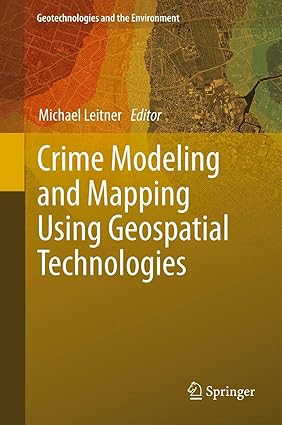
Crime Modeling and Mapping Using Geospatial Technologies (Geotechnologies and the Environment, 8)
by: Michael Leitner (Editor)
Publisher: Springer
Edition: 2013th
Publication Date: 2013-01-18
Language: English
Print Length: 459 pages
ISBN-10: 9400749961
ISBN-13: 9789400749962
Book Description
Recent years in North America have seen a rapid development in the area of crime analysis and mapping using Geographic Information Systems (GIS) technology. In 1996, the US National Institute of Justice (NIJ) established the crime mapping research center (CMRC), to promote research, evaluation, development, and dissemination of GIS technology. The long-term goal is to develop a fully functional Crime Analysis System (CAS) with standardized data collection and reporting mechanisms, tools for spatial and temporal analysis, visualization of data and much more. Among the drawbacks of current crime analysis systems is their lack of tools for spatial analysis. For this reason, spatial analysts should research which current analysis techniques (or variations of such techniques) that have been already successfully applied to other areas (e.g., epidemiology, location-allocation analysis, etc.) can also be employed to the spatial analysis of crime data. This book presents a few of those cases.
Editorial Reviews
Recent years in North America have seen a rapid development in the area of crime analysis and mapping using Geographic Information Systems (GIS) technology. In 1996, the US National Institute of Justice (NIJ) established the crime mapping research center (CMRC), to promote research, evaluation, development, and dissemination of GIS technology. The long-term goal is to develop a fully functional Crime Analysis System (CAS) with standardized data collection and reporting mechanisms, tools for spatial and temporal analysis, visualization of data and much more. Among the drawbacks of current crime analysis systems is their lack of tools for spatial analysis. For this reason, spatial analysts should research which current analysis techniques (or variations of such techniques) that have been already successfully applied to other areas (e.g., epidemiology, location-allocation analysis, etc.) can also be employed to the spatial analysis of crime data. This book presents a few of those cases.