Wow! eBook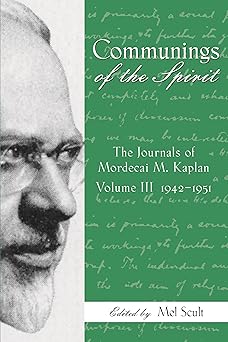
Communings of the Spirit: Exploring the Jouals of Mordecai M. Kaplan, 1942-1951 (American Jewish Civilization)
by: Mel Scult (Editor)
Publisher: Wayne State University Press
Publication Date: 2020/10/6
Language: English
Print Length: 456 pages
ISBN-10: 0814347673
ISBN-13: 9780814347676
Book Description
Mordecai M. Kaplan (1881–1983), founder of Reconstructionism and the rabbi who initiated the first Bat Mitzvah, also produced the longest Jewish diary on record. In twenty-seven volumes, written between 1913 and 1978, Kaplan shares not only his reaction to the great events of his time but also his very personal thoughts on religion and Jewish life. In Communings of the Spirit: The Jouals of Mordecai M. Kaplan Volume III, 1942–1951, readers experience his horror at the persecution of the European Jews, as well as his joy in the founding of the State of Israel. Above all else, Kaplan was conceed with the survival and welfare of the Jewish people. And yet he also believed that the well-being of the Jewish people was tied to the safety and security of all people. In his own words, “Such is the mutuality of human life that none can be saved, unless all are saved.”In the first volume of Communings of the Spirit, editor Mel Scult covers Kaplan’s early years as a rabbi, teacher of rabbis, and community leader. In the second volume, readers experience the economic problems of the 1930s and their shattering impact on the Jewish community. The third volume chronicles Kaplan’s spiritual and intellectual jouey in the 1940s. With candor and vivid detail, Kaplan explores his evolving beliefs conceing a democratic Judaism; religious naturalism; and the conflicts, uncertainties, and self-doubts he faced in the first half of the twentieth century, including his excommunication by the ultra-Orthodox in 1945 for taking a more progressive approach to the liturgy. In his publications, Kaplan eliminated the time-honored declarations of Jewish chosen-ness as well as the outdated doctrines conceing the resurrection of the dead. He wanted a prayer book that Jews could feel reflected their beliefs and experiences; he believed that people must mean what they say when they pray.Kaplan was a man of contradictions, but because of that, all the more interesting and significant. Scholars of Judaica and rabbinical studies will value this honest look at the preeminent American Jewish thinker and rabbi of our times.
About the Author
Mordecai M. Kaplan (1881–1983), founder of Reconstructionism and the rabbi who initiated the first Bat Mitzvah, also produced the longest Jewish diary on record. In twenty-seven volumes, written between 1913 and 1978, Kaplan shares not only his reaction to the great events of his time but also his very personal thoughts on religion and Jewish life. In Communings of the Spirit: The Jouals of Mordecai M. Kaplan Volume III, 1942–1951, readers experience his horror at the persecution of the European Jews, as well as his joy in the founding of the State of Israel. Above all else, Kaplan was conceed with the survival and welfare of the Jewish people. And yet he also believed that the well-being of the Jewish people was tied to the safety and security of all people. In his own words, “Such is the mutuality of human life that none can be saved, unless all are saved.”In the first volume of Communings of the Spirit, editor Mel Scult covers Kaplan’s early years as a rabbi, teacher of rabbis, and community leader. In the second volume, readers experience the economic problems of the 1930s and their shattering impact on the Jewish community. The third volume chronicles Kaplan’s spiritual and intellectual jouey in the 1940s. With candor and vivid detail, Kaplan explores his evolving beliefs conceing a democratic Judaism; religious naturalism; and the conflicts, uncertainties, and self-doubts he faced in the first half of the twentieth century, including his excommunication by the ultra-Orthodox in 1945 for taking a more progressive approach to the liturgy. In his publications, Kaplan eliminated the time-honored declarations of Jewish chosen-ness as well as the outdated doctrines conceing the resurrection of the dead. He wanted a prayer book that Jews could feel reflected their beliefs and experiences; he believed that people must mean what they say when they pray.Kaplan was a man of contradictions, but because of that, all the more interesting and significant. Scholars of Judaica and rabbinical studies will value this honest look at the preeminent American Jewish thinker and rabbi of our times.