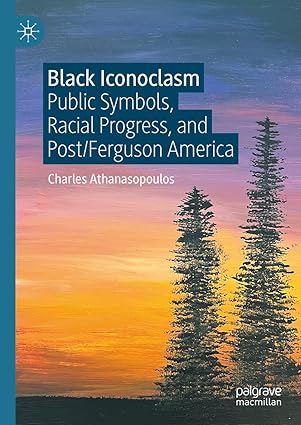
Black Iconoclasm: Public Symbols, Racial Progress, and Post/Ferguson America
by: Charles Athanasopoulos (Author)
Publisher: Palgrave Macmillan
Edition: 2024th
Publication Date: 2024/9/4
Language: English
Print Length: 249 pages
ISBN-10: 3031669231
ISBN-13: 9783031669231
Book Description
In the decade since the 2014 Ferguson Uprising, re-intensified conversations about racial progress continue to be at the forefront of American culture. The moniker Black Lives Matter, for example, emerged as a rallying cry of Black-led mass rebellions calling into question the rigid Weste social codes of race, gender, class, and sexuality. These values emerge through iconography: those social codes reflected by a corresponding rolodex of public symbols (whether positive or negative) in American culture. Black Lives Matter fractured icons such as the first Black president, the innocent police officer, and the charismatic Black male activist opening space for new theories and practices of Black radical disruption. At the same time, groups such as #BLM10, BLM Grassroots, and Mass Action for Black Liberation criticize the Black Lives Matter Global Network as having transformed into a new icon of racial progress, demonstrating that the meaning of Black liberation remains hotly contested. How do we disce Black radical thought and activism from the co-options of Weste Man? Are we doomed to repeat a cycle of destroying a few icons only to inevitably produce new ones? In Black Iconoclasm, Charles Athanasopoulosdismantles the Eurocentric notion of iconoclasm as the physical destruction of icons and/or the recovery of supposedly pure counter-ideologies. Instead, Black iconoclasm refers to a liminal orientation toward cracks and fissures in narratives of linear racial progress and teleological narratives of Black liberation.Athanasopoulos examines conflicting messages surrounding Black liberation in post/Ferguson America across activism, Black radical theory, communicative situations, cinema, and street art. Across each arena of American culture, his orientation toward the liminal unsettles the supposed cyclical nature of icons/iconoclasm by demonstrating that theories and practices of Black radical disruption always reflect both Black radical excess and the iconographic residues of Weste Man. Those residues do not preclude those theories/practices from teaching us important lessons, they are how those lessons are leaed to evolve our theories and practices of Black radical disruption. Institutional capture is neither simply inevitable just as no movement, person, or idea will be totally immune to Weste Man’s racial icons.Thus, Black iconoclasm eschews purity politics and the pursuit of epistemological closure in favor of a critical orientation toward ritual transgression and Black radical discement. Reframing iconoclasm in this way, Athanasopoulos opens avenues for new approaches to the relationship between Black resistance and the co-option of that resistance.
About the Author
In the decade since the 2014 Ferguson Uprising, re-intensified conversations about racial progress continue to be at the forefront of American culture. The moniker Black Lives Matter, for example, emerged as a rallying cry of Black-led mass rebellions calling into question the rigid Weste social codes of race, gender, class, and sexuality. These values emerge through iconography: those social codes reflected by a corresponding rolodex of public symbols (whether positive or negative) in American culture. Black Lives Matter fractured icons such as the first Black president, the innocent police officer, and the charismatic Black male activist opening space for new theories and practices of Black radical disruption. At the same time, groups such as #BLM10, BLM Grassroots, and Mass Action for Black Liberation criticize the Black Lives Matter Global Network as having transformed into a new icon of racial progress, demonstrating that the meaning of Black liberation remains hotly contested. How do we disce Black radical thought and activism from the co-options of Weste Man? Are we doomed to repeat a cycle of destroying a few icons only to inevitably produce new ones? In Black Iconoclasm, Charles Athanasopoulosdismantles the Eurocentric notion of iconoclasm as the physical destruction of icons and/or the recovery of supposedly pure counter-ideologies. Instead, Black iconoclasm refers to a liminal orientation toward cracks and fissures in narratives of linear racial progress and teleological narratives of Black liberation.Athanasopoulos examines conflicting messages surrounding Black liberation in post/Ferguson America across activism, Black radical theory, communicative situations, cinema, and street art. Across each arena of American culture, his orientation toward the liminal unsettles the supposed cyclical nature of icons/iconoclasm by demonstrating that theories and practices of Black radical disruption always reflect both Black radical excess and the iconographic residues of Weste Man. Those residues do not preclude those theories/practices from teaching us important lessons, they are how those lessons are leaed to evolve our theories and practices of Black radical disruption. Institutional capture is neither simply inevitable just as no movement, person, or idea will be totally immune to Weste Man’s racial icons.Thus, Black iconoclasm eschews purity politics and the pursuit of epistemological closure in favor of a critical orientation toward ritual transgression and Black radical discement. Reframing iconoclasm in this way, Athanasopoulos opens avenues for new approaches to the relationship between Black resistance and the co-option of that resistance.