 Wow! eBook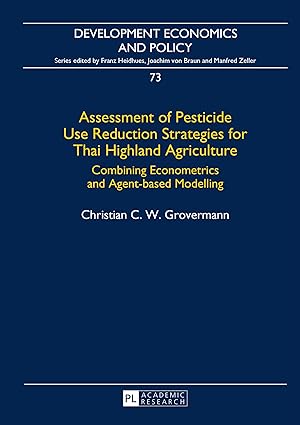
Assessment of Pesticide Use Reduction Strategies for Thai Highland Agriculture: Combining Econometrics and Agent-based Modelling (Development Economics and Policy)
by: Christian Grovermann (Author)
Publisher: Peter Lang GmbH, Internationaler Verlag der Wissenschaften
Edition: New
Publication Date: 2015-03-29
Language: English
Print Length: 197 pages
ISBN-10:
ISBN-13: 9783631657843
Book Description
This study combines econometrics and agent-based modelling to evaluate the impacts of a range of pesticide use reduction strategies in the context of Thai highland agriculture. Pesticide productivity and pesticide overuse are quantified, while determinants of the adoption of innovations in pesticide use reduction are estimated. On that basis, the Mathematical Programming-based Multi Agent System (MPMAS), a bio-economic simulation model, is used to ex-ante assess the adoption of Integrated Pest Management (IPM) in combination with a series of market-based instruments that boost the transition to more sustainable pest control practices. The MPMAS simulation results demonstrate that, over five years, it is possible to bring down levels of pesticide use significantly without income trade-offs for farm agents. A proportional tax, increasing the price of synthetic pesticides by 50% on average, together with bio-pesticide subsidies for IPM proves to be the most cost-effective and practicable policy package. IPM practices are adopted by up to 75% of farm agents and pesticide use reductions reach up to 34%.
Editorial Reviews
This study combines econometrics and agent-based modelling to evaluate the impacts of a range of pesticide use reduction strategies in the context of Thai highland agriculture. Pesticide productivity and pesticide overuse are quantified, while determinants of the adoption of innovations in pesticide use reduction are estimated. On that basis, the Mathematical Programming-based Multi Agent System (MPMAS), a bio-economic simulation model, is used to ex-ante assess the adoption of Integrated Pest Management (IPM) in combination with a series of market-based instruments that boost the transition to more sustainable pest control practices. The MPMAS simulation results demonstrate that, over five years, it is possible to bring down levels of pesticide use significantly without income trade-offs for farm agents. A proportional tax, increasing the price of synthetic pesticides by 50% on average, together with bio-pesticide subsidies for IPM proves to be the most cost-effective and practicable policy package. IPM practices are adopted by up to 75% of farm agents and pesticide use reductions reach up to 34%.


