 Wow! eBook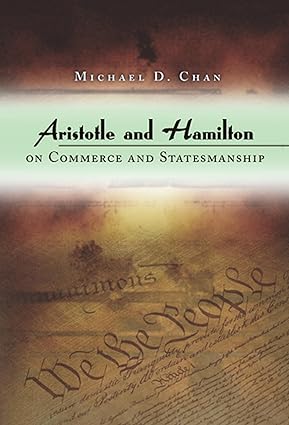
Aristotle and Hamilton on Commerce and Statesmanship (Volume 1)
by: Michael D. Chan (Author)
Publisher: University of Missouri
Publication Date: 2006/7/1
Language: English
Print Length: 248 pages
ISBN-10: 0826216390
ISBN-13: 9780826216397
Book Description
Although America’s founders may have been inspired by the political thought of ancient Greece and Rome, the United States is more often characterized by its devotion to the pursuit of commerce. Some have even said that a mode commercial republic such as the United States unavoidably lowers its moral horizon to little more than a conce with securing peace and prosperity so that commerce can flourish.Michael Chan reconsiders this view of America through close readings of Aristotle and Alexander Hamilton, showing that America at its founding was neither as mode nor as low as we have been led to believe. He challenges the virtue/commerce divide that dominates mode thought by demonstrating that the prevailing views of Aristotle and Hamilton on commerce reflect misleading half-truths.Chan first examines Aristotle’s views of economics as presented in the Politics, arguing that Aristotle was not as hostile to commerce as is commonly believed. He points out the philosopher’s belief in the value of commercial acquisition in the interest of supplying citizens with the “equipment of virtue,” citing Aristotle’s praise of commercial Carthage over agrarian but much-esteemed Sparta.Chan then tus to a detailed account of the political economy of Hamilton, a proponent of an advanced industrial republic modeled on Great Britain. While many take Hamilton’s advocacy of public credit, a national bank, and manufacturing as evidence of his rejection of classical republican thought in favor of modeity, Chan contends that Hamilton embraced a classically inspired economic statesmanship that transcended a conce with merely securing peace and prosperity. Leading the reader through the complexities of Hamilton’s thought, Chan shows that he intended commerce to pursue the wider classical goals of forming the character of citizens, establishing harmony and justice, and pursuing national greatness. Rather than attempting to brand Hamilton an Aristotelian, Chan seeks to incorporate into the study of Hamilton’s political economy what Aristotle himself regarded as the statesman’s characteristic virtue, prudence.By reflecting on Hamilton in the context of Aristotle’s own reflections on commerce, Chan casts him in a new light that cuts across the ongoing debate about liberal versus classical republican elements of the American founding. His cogent analysis also raises important questions regarding the American system as it is being challenged by conflicting worldviews. Aristotle and Hamilton on Commerce and Statesmanship makes a significant contribution to our understanding of both Hamiltonian thought and the moral worthiness of democratic capitalism.
About the Author
Although America’s founders may have been inspired by the political thought of ancient Greece and Rome, the United States is more often characterized by its devotion to the pursuit of commerce. Some have even said that a mode commercial republic such as the United States unavoidably lowers its moral horizon to little more than a conce with securing peace and prosperity so that commerce can flourish.Michael Chan reconsiders this view of America through close readings of Aristotle and Alexander Hamilton, showing that America at its founding was neither as mode nor as low as we have been led to believe. He challenges the virtue/commerce divide that dominates mode thought by demonstrating that the prevailing views of Aristotle and Hamilton on commerce reflect misleading half-truths.Chan first examines Aristotle’s views of economics as presented in the Politics, arguing that Aristotle was not as hostile to commerce as is commonly believed. He points out the philosopher’s belief in the value of commercial acquisition in the interest of supplying citizens with the “equipment of virtue,” citing Aristotle’s praise of commercial Carthage over agrarian but much-esteemed Sparta.Chan then tus to a detailed account of the political economy of Hamilton, a proponent of an advanced industrial republic modeled on Great Britain. While many take Hamilton’s advocacy of public credit, a national bank, and manufacturing as evidence of his rejection of classical republican thought in favor of modeity, Chan contends that Hamilton embraced a classically inspired economic statesmanship that transcended a conce with merely securing peace and prosperity. Leading the reader through the complexities of Hamilton’s thought, Chan shows that he intended commerce to pursue the wider classical goals of forming the character of citizens, establishing harmony and justice, and pursuing national greatness. Rather than attempting to brand Hamilton an Aristotelian, Chan seeks to incorporate into the study of Hamilton’s political economy what Aristotle himself regarded as the statesman’s characteristic virtue, prudence.By reflecting on Hamilton in the context of Aristotle’s own reflections on commerce, Chan casts him in a new light that cuts across the ongoing debate about liberal versus classical republican elements of the American founding. His cogent analysis also raises important questions regarding the American system as it is being challenged by conflicting worldviews. Aristotle and Hamilton on Commerce and Statesmanship makes a significant contribution to our understanding of both Hamiltonian thought and the moral worthiness of democratic capitalism.


