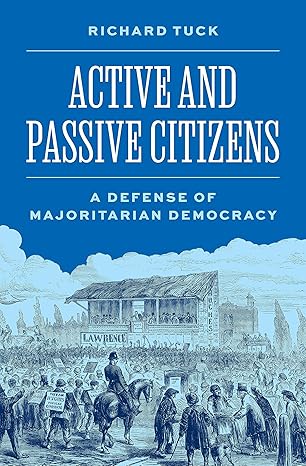
Active and Passive Citizens: A Defense of Majoritarian Democracy (The University Center for Human Values Series, 57)
by: Richard Tuck (Author),Stephen Macedo(Editor),Melissa Schwartzberg(Contributor),John Ferejohn(Contributor),Joshua Cohen(Contributor),Simone Chambers(Contributor)
Publisher: Princeton University Press
Publication Date: April 30, 2024
Language: English
Print Length: 208 pages
ISBN-10: 0691242798
ISBN-13: 9780691242798
Book Description
A powerful case for why majority rule—not representation—is the defining feature of democratic politicsThe idea that democratic goveance rests on active self-rule by citizens plays surprisingly little part in current theories of democracy, which instead stress the importance of representation by elected, appointed, or randomly selected bodies such as legislatures, courts, and juries. This would have astonished eighteenth-century theorists of democracy, who viewed universal suffrage and majoritarian voting as the sole criteria for democratic politics. Active and Passive Citizens defends the view of these earlier thinkers, asserting that individual agency is the very essence of democracy.In this provocative and lucidly argued book, Richard Tuck draws on the distinction made by the Abbé Sieyès, a leading political theorist of the French Revolution, between “active” citizens (the electorate) and “passive” ones (those who are represented by the institutions of the state). Tuck traces our current representative view of democracy to Sieyès and contrasts him with Rousseau, a theorist of active self-rule by the people. Tuck argues that mode theories of democracy have effectively tued us into passive citizens and calls for a renewal of a majoritarian democracy that realizes the full potential of active citizenship.Based on the prestigious Tanner Lectures delivered at Princeton University’s Center for Human Values, Active and Passive Citizens is edited and introduced by Stephen Macedo and includes commentary by political theorists Simone Chambers, Joshua Cohen, John Ferejohn, and Melissa Schwartzberg.
A powerful case for why majority rule—not representation—is the defining feature of democratic politicsThe idea that democratic goveance rests on active self-rule by citizens plays surprisingly little part in current theories of democracy, which instead stress the importance of representation by elected, appointed, or randomly selected bodies such as legislatures, courts, and juries. This would have astonished eighteenth-century theorists of democracy, who viewed universal suffrage and majoritarian voting as the sole criteria for democratic politics. Active and Passive Citizens defends the view of these earlier thinkers, asserting that individual agency is the very essence of democracy.In this provocative and lucidly argued book, Richard Tuck draws on the distinction made by the Abbé Sieyès, a leading political theorist of the French Revolution, between “active” citizens (the electorate) and “passive” ones (those who are represented by the institutions of the state). Tuck traces our current representative view of democracy to Sieyès and contrasts him with Rousseau, a theorist of active self-rule by the people. Tuck argues that mode theories of democracy have effectively tued us into passive citizens and calls for a renewal of a majoritarian democracy that realizes the full potential of active citizenship.Based on the prestigious Tanner Lectures delivered at Princeton University’s Center for Human Values, Active and Passive Citizens is edited and introduced by Stephen Macedo and includes commentary by political theorists Simone Chambers, Joshua Cohen, John Ferejohn, and Melissa Schwartzberg.