Wow! eBook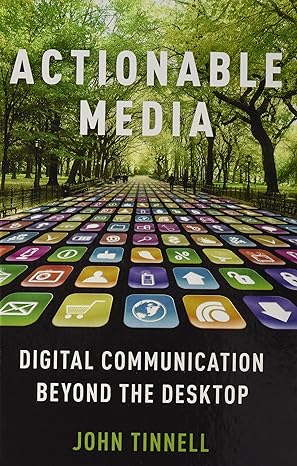
Actionable Media: Digital Communication Beyond the Desktop
by: John Tinnell (Author)
Publisher: Oxford University Press
Edition: 1st
Publication Date: 2017/11/1
Language: English
Print Length: 280 pages
ISBN-10: 0190678070
ISBN-13: 9780190678074
Book Description
In 1991, Mark Weiser and his team at Xerox PARC declared they were reinventing computers for the twenty-first century. The computer would become integrated into the fabric of everyday life; it would shift to the background rather than being itself an object of focus. The resulting rise of ubiquitous computing (smartphones, smartglasses, smart cities) have since thoroughly colonized our digital landscape. In Actionable Media, John Tinnell contends that there is an unsung rhetorical dimension to Weiser’s legacy, which stretches far beyond recent iProducts. Taking up Weiser’s motto, “Start from the arts and humanities,” Tinnell develops a theoretical framework for understanding nascent initiatives–the Inteet of things, wearable interfaces, augmented reality–in terms of their intellectual history, their relationship to earlier communication technologies, and their potential to become vibrant platforms for public culture and critical media production.It is clear that an ever-widening array of everyday spaces now double as venues for multimedia authorship. Writers, activists, and students, in cities and towns everywhere, are digitally augmenting physical environments. Audio walks embed narratives around local parks for pedestrians to encounter during a stroll; online forums are woven into urban infrastructure and suburban plazas to invigorate community politics. This new wave of digital communication, which Tinnell terms “actionable media,” is presented through case studies of exemplar projects by leading artists, designers, and research-creation teams. Chapters alter notions of ubiquitous computing through concepts drawn from Beard Stiegler, Gregory Ulmer, and Hannah Arendt; from comparative media analyses with writing systems such as cuneiform, urban signage, and GUI software; and from relevant stylistic insights gleaned from the open air arts practices of Augusto Boal, Claude Monet, and Janet Cardiff. Actionable Media challenges familiar claims about the combination of physical and digital spaces, beckoning contemporary media studies toward an alteative substrate of historical precursors, emerging forms, design philosophies, and rhetorical principles.
About the Author
In 1991, Mark Weiser and his team at Xerox PARC declared they were reinventing computers for the twenty-first century. The computer would become integrated into the fabric of everyday life; it would shift to the background rather than being itself an object of focus. The resulting rise of ubiquitous computing (smartphones, smartglasses, smart cities) have since thoroughly colonized our digital landscape. In Actionable Media, John Tinnell contends that there is an unsung rhetorical dimension to Weiser’s legacy, which stretches far beyond recent iProducts. Taking up Weiser’s motto, “Start from the arts and humanities,” Tinnell develops a theoretical framework for understanding nascent initiatives–the Inteet of things, wearable interfaces, augmented reality–in terms of their intellectual history, their relationship to earlier communication technologies, and their potential to become vibrant platforms for public culture and critical media production.It is clear that an ever-widening array of everyday spaces now double as venues for multimedia authorship. Writers, activists, and students, in cities and towns everywhere, are digitally augmenting physical environments. Audio walks embed narratives around local parks for pedestrians to encounter during a stroll; online forums are woven into urban infrastructure and suburban plazas to invigorate community politics. This new wave of digital communication, which Tinnell terms “actionable media,” is presented through case studies of exemplar projects by leading artists, designers, and research-creation teams. Chapters alter notions of ubiquitous computing through concepts drawn from Beard Stiegler, Gregory Ulmer, and Hannah Arendt; from comparative media analyses with writing systems such as cuneiform, urban signage, and GUI software; and from relevant stylistic insights gleaned from the open air arts practices of Augusto Boal, Claude Monet, and Janet Cardiff. Actionable Media challenges familiar claims about the combination of physical and digital spaces, beckoning contemporary media studies toward an alteative substrate of historical precursors, emerging forms, design philosophies, and rhetorical principles.