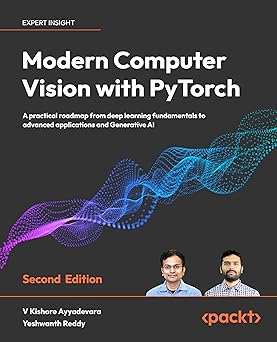
Mode Computer Vision with PyTorch – Second Edition: A practical roadmap from deep leaing fundamentals to advanced applications and Generative AI
by: V Kishore Ayyadevara (Author),Yeshwanth Reddy(Author)
Publisher: Packt Publishing
Edition: 2nd ed.
Publication Date: 2024/6/10
Language: English
Print Length: 746 pages
ISBN-10: 1803231335
ISBN-13: 9781803231334
Book Description
The definitive computer vision book is back, featuring the latest neural network architectures and an exploration of foundation and diffusion modelsPurchase of the print or Kindle book includes a free eBook in PDF formatKey Features- Understand the inner workings of various neural network architectures and their implementation, including image classification, object detection, segmentation, generative adversarial networks, transformers, and diffusion models- Build solutions for real-world computer vision problems using PyTorch- All the code files are available on GitHub and can be run on Google ColabBook DescriptionWhether you are a beginner or are looking to progress in your computer vision career, this book guides you through the fundamentals of neural networks (NNs) and PyTorch and how to implement state-of-the-art architectures for real-world tasks.The second edition of Mode Computer Vision with PyTorch is fully updated to explain and provide practical examples of the latest multimodal models, CLIP, and Stable Diffusion.You’ll discover best practices for working with images, tweaking hyperparameters, and moving models into production. As you progress, you’ll implement various use cases for facial keypoint recognition, multi-object detection, segmentation, and human pose detection. This book provides a solid foundation in image generation as you explore different GAN architectures. You’ll leverage transformer-based architectures like ViT, TrOCR, BLIP2, and LayoutLM to perform various real-world tasks and build a diffusion model from scratch. Additionally, you’ll utilize foundation models’ capabilities to perform zero-shot object detection and image segmentation. Finally, you’ll lea best practices for deploying a model to production.By the end of this deep leaing book, you’ll confidently leverage mode NN architectures to solve real-world computer vision problems.What you will lea- Get to grips with various transformer-based architectures for computer vision, CLIP, Segment-Anything, and Stable Diffusion, and test their applications, such as in-painting and pose transfer- Combine CV with NLP to perform OCR, key-value extraction from document images, visual question-answering, and generative AI tasks- Implement multi-object detection and segmentation- Leverage foundation models to perform object detection and segmentation without any training data points- Lea best practices for moving a model to productionWho this book is forThis book is for beginners to PyTorch and intermediate-level machine leaing practitioners who want to lea computer vision techniques using deep leaing and PyTorch. It’s useful for those just getting started with neural networks, as it will enable readers to lea from real-world use cases accompanied by notebooks on GitHub. Basic knowledge of the Python programming language and ML is all you need to get started with this book. For more experienced computer vision scientists, this book takes you through more advanced models in the latter part of the book.Table of Contents- Artificial Neural Network Fundamentals- PyTorch Fundamentals- Building a Deep Neural Network with PyTorch- Introducing Convolutional Neural Networks- Transfer Leaing for Image Classification- Practical Aspects of Image Classification- Basics of Object Detection- Advanced Object Detection- Image Segmentation- Applications of Object Detection and Segmentation- Autoencoders and Image Manipulation- Image Generation Using GANs(N.B. Please use the Read Sample option to see further chapters)
About the Author
The definitive computer vision book is back, featuring the latest neural network architectures and an exploration of foundation and diffusion modelsPurchase of the print or Kindle book includes a free eBook in PDF formatKey Features- Understand the inner workings of various neural network architectures and their implementation, including image classification, object detection, segmentation, generative adversarial networks, transformers, and diffusion models- Build solutions for real-world computer vision problems using PyTorch- All the code files are available on GitHub and can be run on Google ColabBook DescriptionWhether you are a beginner or are looking to progress in your computer vision career, this book guides you through the fundamentals of neural networks (NNs) and PyTorch and how to implement state-of-the-art architectures for real-world tasks.The second edition of Mode Computer Vision with PyTorch is fully updated to explain and provide practical examples of the latest multimodal models, CLIP, and Stable Diffusion.You’ll discover best practices for working with images, tweaking hyperparameters, and moving models into production. As you progress, you’ll implement various use cases for facial keypoint recognition, multi-object detection, segmentation, and human pose detection. This book provides a solid foundation in image generation as you explore different GAN architectures. You’ll leverage transformer-based architectures like ViT, TrOCR, BLIP2, and LayoutLM to perform various real-world tasks and build a diffusion model from scratch. Additionally, you’ll utilize foundation models’ capabilities to perform zero-shot object detection and image segmentation. Finally, you’ll lea best practices for deploying a model to production.By the end of this deep leaing book, you’ll confidently leverage mode NN architectures to solve real-world computer vision problems.What you will lea- Get to grips with various transformer-based architectures for computer vision, CLIP, Segment-Anything, and Stable Diffusion, and test their applications, such as in-painting and pose transfer- Combine CV with NLP to perform OCR, key-value extraction from document images, visual question-answering, and generative AI tasks- Implement multi-object detection and segmentation- Leverage foundation models to perform object detection and segmentation without any training data points- Lea best practices for moving a model to productionWho this book is forThis book is for beginners to PyTorch and intermediate-level machine leaing practitioners who want to lea computer vision techniques using deep leaing and PyTorch. It’s useful for those just getting started with neural networks, as it will enable readers to lea from real-world use cases accompanied by notebooks on GitHub. Basic knowledge of the Python programming language and ML is all you need to get started with this book. For more experienced computer vision scientists, this book takes you through more advanced models in the latter part of the book.Table of Contents- Artificial Neural Network Fundamentals- PyTorch Fundamentals- Building a Deep Neural Network with PyTorch- Introducing Convolutional Neural Networks- Transfer Leaing for Image Classification- Practical Aspects of Image Classification- Basics of Object Detection- Advanced Object Detection- Image Segmentation- Applications of Object Detection and Segmentation- Autoencoders and Image Manipulation- Image Generation Using GANs(N.B. Please use the Read Sample option to see further chapters)