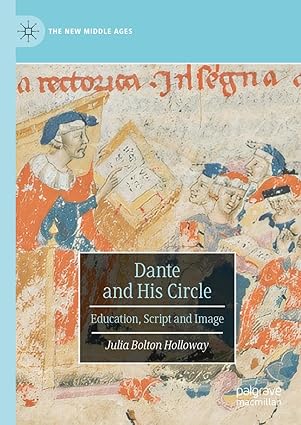
Dante and His Circle: Education, Script and Image (The New Middle Ages)
by: Julia Bolton Holloway (Author)
Publisher: Palgrave Macmillan
Edition: 2024th
Publication Date: 2024/5/15
Language: English
Print Length: 369 pages
ISBN-10: 3031440927
ISBN-13: 9783031440922
Book Description
In this book, Julia Bolton Holloway makes use of primary materials in documents, manuscripts and stone monuments in Florence, to place Dante’s literary career in its rich context. Dante and His Circle discusses the encyclopaedic multicultural education in classical literature, law, ethics, rhetoric, diplomacy, poetry, music and cosmology Brunetto Latino gave to Guido Cavalcante, Dante Alighieri and Francesco da Barberino. Bolton Holloway traces Latino’s use of Arabic methods he had leaed at the Court of Alfonso X el Sabio in Spain in 1260. Next Latino dictates his ‘Rettorica’, ‘Tesoretto’ and ‘Tesoro’ in Italian to his students, following the Sicilian Vespers, the manuscripts of their circle later coming to be re-edited, illustrated and published by Dante’s fellow student, Francesco da Barberino, who survived them all and who likewise copied Alfonsine methods for producing the ‘Danti del Cento’ manuscripts of the ‘Commedia’. The book ends by discussing Dante’s Decolonialism. Each chapter provides Study Questions for further research.
About the Author
In this book, Julia Bolton Holloway makes use of primary materials in documents, manuscripts and stone monuments in Florence, to place Dante’s literary career in its rich context. Dante and His Circle discusses the encyclopaedic multicultural education in classical literature, law, ethics, rhetoric, diplomacy, poetry, music and cosmology Brunetto Latino gave to Guido Cavalcante, Dante Alighieri and Francesco da Barberino. Bolton Holloway traces Latino’s use of Arabic methods he had leaed at the Court of Alfonso X el Sabio in Spain in 1260. Next Latino dictates his ‘Rettorica’, ‘Tesoretto’ and ‘Tesoro’ in Italian to his students, following the Sicilian Vespers, the manuscripts of their circle later coming to be re-edited, illustrated and published by Dante’s fellow student, Francesco da Barberino, who survived them all and who likewise copied Alfonsine methods for producing the ‘Danti del Cento’ manuscripts of the ‘Commedia’. The book ends by discussing Dante’s Decolonialism. Each chapter provides Study Questions for further research.