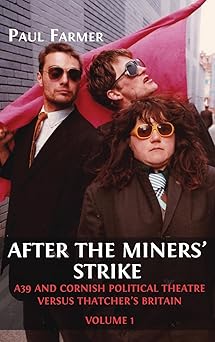
After the Miners’ Strike: A39 and Coish Political Theatre versus Thatcher’s Britain
by: Paul Farmer (Author),Rebecca Hillman(Preface)
Publisher: Open Book Publishers
Publication Date: 2023/9/27
Language: English
Print Length: 284 pages
ISBN-10: 1800649134
ISBN-13: 9781800649132
Book Description
In this rich memoir, the first of two volumes, Paul Farmer traces the story of A39, the Coish political theatre group he co-founded and ran from the mid-1980s to the early 1990s. Farmer offers a unique insight into A39’s creation, operation, and artistic practice during a period of convulsive political and social change. The reader is plunged into the national miners’ strike and the collapse of Coish tin mining, the impact of Thatcherism and ‘Reaganomics’, and the experience of touring Germany on the brink of reunification, alongside the influence on A39 of writers Bertolt Brecht, John McGrath and Keith Johnstone. Farmer, a former bus driver tued artistic director, details the theatre group’s inception and development as it fought to break down social barriers, attract audiences, and survive with little more than a beaten-up Renault 12, a photocopier and two second-hand stage lights at its disposal: the book traces the progress from these raw materials to the development of an integrated community theatre practice for Cowall.Farmer’s candour and humour enliven this unique insight into 1980s theatre and politics. It will appeal to anyone with an interest in theatre history, life in Cowall, and the relationship between performance and society during a turbulent era.
About the Author
In this rich memoir, the first of two volumes, Paul Farmer traces the story of A39, the Coish political theatre group he co-founded and ran from the mid-1980s to the early 1990s. Farmer offers a unique insight into A39’s creation, operation, and artistic practice during a period of convulsive political and social change. The reader is plunged into the national miners’ strike and the collapse of Coish tin mining, the impact of Thatcherism and ‘Reaganomics’, and the experience of touring Germany on the brink of reunification, alongside the influence on A39 of writers Bertolt Brecht, John McGrath and Keith Johnstone. Farmer, a former bus driver tued artistic director, details the theatre group’s inception and development as it fought to break down social barriers, attract audiences, and survive with little more than a beaten-up Renault 12, a photocopier and two second-hand stage lights at its disposal: the book traces the progress from these raw materials to the development of an integrated community theatre practice for Cowall.Farmer’s candour and humour enliven this unique insight into 1980s theatre and politics. It will appeal to anyone with an interest in theatre history, life in Cowall, and the relationship between performance and society during a turbulent era.